The Vision
Infinite Worlds.
One Engine.
Limitless Potential.
Odyssey is an immersive reality engine that opens the door to every world imaginable — and builds the ones that haven't been imagined yet.
I. The Idea
A Door Into Every World
Odyssey began with a deceptively simple premise: what if technology could place you — fully, convincingly, consequentially — inside any world you could describe?
Not a game with predefined outcomes. Not a simulation with guardrails. A living, adaptive environment that responds to your choices with the depth and unpredictability of reality itself. A medieval court where your diplomacy has real political consequences. A deep-sea expedition where every decision reshapes the mission. A jazz club in 1940s Harlem where the music shifts with the room.
“The most powerful technology disappears. What remains is the experience.”
That conviction — that the technology should vanish behind the world it creates — became the founding principle of Odyssey. Every architectural decision, every model integration, every interface choice flows from it.
The Engine
Worlds That Think, Adapt, and Respond
At the core of Odyssey is an immersive reality engine capable of generating, maintaining, and evolving entire worlds in real time. It holds persistent memory of characters, environments, and consequences. It adapts narratives to your decisions without breaking coherence.
The engine is built on advances in large-scale language models, real-time state management, and adaptive narrative architecture — technologies that simply did not exist at this level of maturity until now.
II. The Opportunity
What Infinite Worlds Unlock
When you can step into any world with full consequence and fidelity, entirely new categories of value emerge — across entertainment, education, professional development, and human understanding.
Dimension I
Experiential Understanding
Know It by Living It
Experiential understanding transforms preparation into reality. Imagine someone who wants to overcome their fear of public speaking or sharpen their ability to communicate under pressure. Instead of rehearsing alone, they step into a simulation where they are presenting in front of a live audience that reacts in real time—showing engagement, boredom, judgment, or approval through realistic emotional responses. They can practice in different environments, from job interviews to high-stakes presentations in front of judges, and even control the difficulty of the room—whether it's a supportive audience or a critical panel designed to challenge them.
Today, this experience begins through advanced audio-based interaction, but the vision extends far beyond. With full VR integration, users will stand inside lifelike environments surrounded by human avatars that express emotion through facial expressions, tone, and body language—making the experience feel indistinguishable from reality. Through repeated exposure in these immersive scenarios, fear begins to dissolve, confidence becomes natural, and communication transforms into a mastered skill rather than a source of doubt.
Dimension II
High-Fidelity Preparation
Rehearsal at the Speed of Reality
High-fidelity preparation turns practice into measurable performance. Surgeons rehearse before operating. Pilots train before flying. Odyssey extends that same principle to communication, leadership, negotiation, and crisis response through realistic simulation loops that let users fail safely, adjust quickly, and improve with intent.
As users move from Dimension I's emotional realism into repeatable high-pressure drills, they build not only confidence but consistency. The result is readiness that transfers beyond the simulation and into real-world decision-making.
Dimension III
Creative & Narrative Innovation
Stories You Don't Watch — You Inhabit
Creative and narrative innovation allows users to build entirely new worlds from knowledge itself. Imagine a history teacher who wants her students to truly understand the era of Napoleon. Instead of relying solely on lectures and textbooks, she gathers everything available—historical documents, lesson plans, primary sources—and feeds it into the system. From that, she creates a fully immersive world where Napoleon himself guides the student through his time period, walking them through key events, decisions, and environments as if they were living inside history.
Every piece of knowledge that would normally be studied for a test is embedded directly into the experience. To progress through the simulation, students must remember and apply what they’ve learned, unlocking new parts of the world as they demonstrate understanding. The result is not just memorization, but true comprehension—where education becomes an interactive journey, and learning feels like living through the story rather than reading about it.
Where It Began
The First Worlds
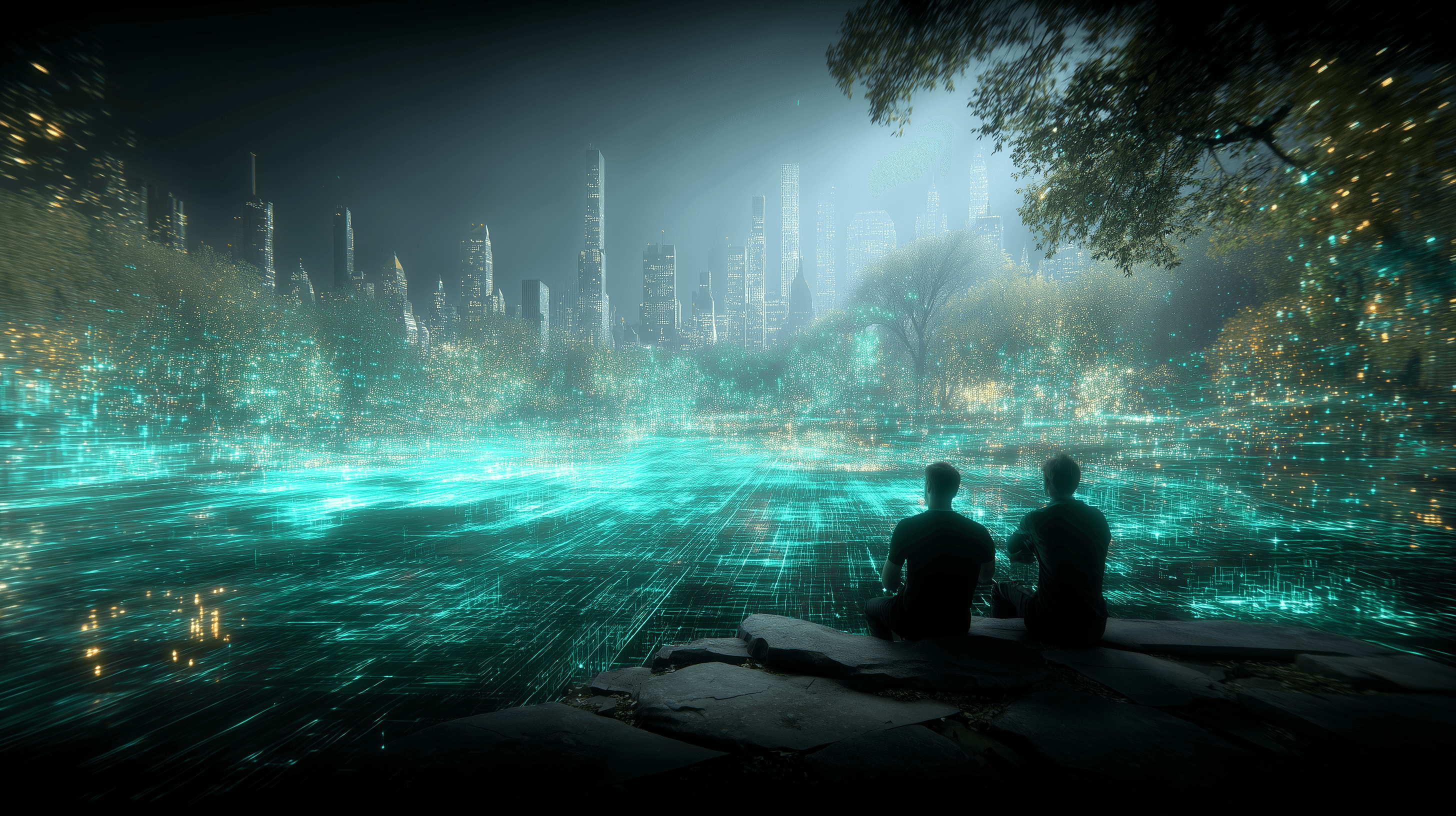
Before the engine, before the architecture — there were two questions asked on a rock in Central Park that set everything in motion.
World I
What Would It Feel Like to Be a King?
Not a figurehead. Not a character in a game. A real king — burdened by the weight of a crown, surrounded by advisors whose loyalty you can never quite verify, responsible for thousands of lives shaped by every decision you make.
The loneliness at the top of the tower. The impossible calculus of mercy versus order. The moment you realize the throne doesn't grant wisdom — it demands it.
This was the first question. The one that cracked the door open.
World II
What Would It Feel Like to Be a Pirate?
Salt air. A crew that follows you only as long as you're worth following. A horizon that promises nothing and everything at once. The raw, ungoverned freedom of a life lived outside every structure the world tried to put you in.
The thrill of the chase. The code that only matters when you choose to honor it. The discovery that freedom without purpose is just drift.
This was the second question. The one that proved the first wasn't a fluke.
Two worlds. Two very different lives. But the same underlying revelation: the technology to make this real would change everything. Odyssey is the proof.
III. The Team
The Founders
Two builders with the vision to see what's possible and the resolve to make it real.

Co-founder
Binny Plotkin
A builder and storyteller drawn to the intersection of technology, mythology, and the inner life. His work is rooted in the belief that within each person lives a vast inner infinity — and that the most powerful experiences help us return to it.

Co-founder
Josh Sassoon
A builder with an uncommon capacity to hold vision and execution in the same hand. He has a rare instinct for identifying the questions worth asking, and the conviction to pursue them before the path is clear.
IV. The Moment
Why Now
For decades, the vision of truly immersive, adaptive worlds existed only in science fiction. The computational infrastructure, the language understanding, the real-time narrative coherence — none of it was technically feasible at scale.
That changed. Large language models capable of holding entire worlds in memory, generating coherent consequence and dialogue, and adapting to user choices in real time have reached a threshold of maturity that makes Odyssey not just possible — but inevitable.
The appetite for this kind of experience is ancient and universal. The technology is finally here. Odyssey exists at the precise intersection of the two — and the market it opens is as vast as the worlds it creates.
“The only way to discover the limits of the possible is to venture past them into the impossible.”
Arthur C. Clarke
Odyssey is building the door. The worlds are waiting.